All Products > High Performance Plastics
PVDF (Polyvinylidene Fluoride)
Polyvinylidene Fluoride (PVDF) is a semi-crystalline, highly inert, tough, and dimensionally stable fluoropolymer thermoplastic. It typically features a molecular weight in the range of 400,000–600,000, a crystallinity of approximately 60–80%, and a fluorine content of about 59% by weight. PVDF can be continuously used in a temperature range from -50°C to +150°C.
PVDF exhibits a melting temperature between 170°C and 185°C and undergoes significant thermal decomposition at approximately 350–380°C, releasing hydrogen fluoride (HF). Due to the relatively wide processing window between melting and decomposition, PVDF is well-suited for conventional thermoplastic processing methods such as injection molding and extrusion, typically performed at melt temperatures of 200–250°C.
PVDF is considered one of the most radiation-resistant thermoplastics available, though it is generally ranked below high-performance polymers such as Polyether ether ketone. It combines the chemical resistance typical of fluoropolymers with the processability of conventional thermoplastics. PVDF demonstrates excellent resistance to chemicals, oxidation, weathering, and radiation exposure. Additionally, it exhibits functional properties such as piezoelectricity, dielectric behavior, and pyroelectric response.
PVDF shows strong resistance to a wide range of chemicals, including organic acids, aliphatic and aromatic hydrocarbons, alcohols, and halogenated solvents. However, it has limited resistance to strong bases and certain ketones, especially under elevated temperatures.
MANUFACTURED Material
Custom PVDF Products
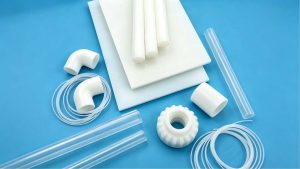
We supply a complete line of standard and custom PVDF fittings, including:
- PVDF Elbows (90°, 45°)– Smooth bore design for low pressure drop and efficient flow turning.
- PVDF Tees (Equal and Reducing) – For reliable branching and merging of fluid lines.
- PVDF Flanges – Butt-welded or socket-type, ideal for bolting connections in tanks and valves.
- PVDF Unions (Halves/By halves) – Also known as “PVDF by halves” or “sanitary unions”, perfect for easy maintenance and disassembly.
- Reducers, Caps, Crosses, and Custom Fabricated Fittings – Available upon request.
- PVDF pipe (From 16 to 450mm OD)
We provide custom dimensions to meet your needs.
Key Properties of PVDF
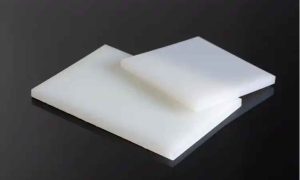
Polyvinylidene Fluoride (PVDF) is a semi-crystalline fluoropolymer widely used in applications requiring a balance of chemical resistance, mechanical strength, and thermal stability. Compared to fully fluorinated materials, PVDF provides better rigidity and easier processing, making it suitable for both machined components and sealing applications.
- Excellent chemical resistance to acids and hydrocarbons
- Good mechanical strength and wear resistance
- Continuous service temperature up to ~150°C
- Low permeability to gases and liquids
- Strong UV and weather resistance
- Good electrical insulation properties
| Property | PTFE | PVDF | PEEK |
|---|---|---|---|
| Chemical Resistance | Excellent | Very Good | Good |
| Temperature Resistance | Up to 260°C | Up to 150°C | Up to 250°C |
| Mechanical Strength | Low | Medium–High | High |
| Processability | Difficult | Easy | Moderate |
| Cost | Low–Medium | Medium | High |
*Engineering Insight: PVDF provides a practical balance between PTFE and PEEK in terms of cost, strength, and chemical resistance.
Chemical Resistance
PVDF performs well in:
- Strong acids (e.g., sulfuric acid, hydrochloric acid)
- Aliphatic and aromatic hydrocarbons
- Alcohols and halogenated solvents
Limitations:
- Poor resistance to strong bases (especially at high temperatures)
- Sensitive to certain ketones (e.g., acetone, MEK)
PVDF for Applications
PVDF is used in sealing systems where mechanical strength and chemical resistance must be balanced. It is particularly suitable for applications that require better rigidity and wear resistance than PTFE.
Suitable Applications:
- Chemical tank liners
- Semiconductor equipment components
- Pipe &Fittings, seal and gaskets
- Pump and valve parts
- Corrosive fluid handling
- Plating tanks
- Food and pharmaceutical industries
- Nozzle
When to Choose PVDF:
- Need higher stiffness and load capacity than PTFE
- Operating temperature below 150°C
- Cost-sensitive compared to PEEK
- Precision machining required
- Excellent weld ability
- UV resistance
- Excellent ageing properties
- High purity
When NOT to Use PVDF:
- Strong alkaline environments
- Continuous high temperature above 150°C
- Extreme chemical inertness required (PTFE preferred)
Why Choose Hansealing
- Standard materials: 3–7 days
- Custom parts: 7–15 days
- Precision machining based on drawings
- Material grade selection (standard / high-purity)
- Prototype and small batch support
- Stable raw material sourcing
- Consistent batch quality
- Support for industrial and high-purity applications
Have Questions?
Talk with our experts today and let us help you figure out the best solution.