Home > Spring Energized Seals > Helical Spring Seals > Internal Pressure Helical Spring Energized Face Seal
Internal Pressure Helical Spring Energized Face Seal (Code: HHS002)
HHS002 seals between two stationary faces when the higher pressure is at the inside diameter. Install the seal with its spring cavity facing the ID. The spring preloads the axial sealing lips before system pressure rises.
Features & Benefits
-
The inward-facing cavity admits pressure from the bore.
-
Axial lip contact seals the joint between the two mating faces.
-
Spring preload maintains initial face contact at low differential pressure.
Typical Applications
-
Static flange or cover joints with a pressurized bore
-
Gas or refrigerant joints with pressure on the ID side

Technical Details
The operating limits of a spring energized seal depend on the jacket material, spring design, pressure, temperature, motion and hardware clearances.
The ranges below are preliminary selection references and should not be treated as guaranteed ratings for every seal configuration. Please confirm the applicable limits for your specific design and operating conditions.
Motion & Pressure Action
Coloured icons show the primary duty, applications requiring review and the specified pressure action.
Grey icons mark duties outside the published configuration.

Reciprocating
Not specified

Rotary
Not specified

Helical Motion
Not specified

Oscillating
Not specified

Static
Primary application

Double-Acting
Not specified

Single-Acting
Pressure from one direction
| Types | SEAL ID(mm | in) | Pressure(Mpa | Psi) | Temp. Range(℃ | °F) | Velocity(m/s) |
|---|---|---|---|---|
| Static seal | 3~2200 (.118-86.614) | ≤20 MPa (2,900 psi) | -200~320 ℃ (-328 +608 °F) | 0 |
| *Important Note: Maximum values are subject to seal material, spring configuration, extrusion gap, mating surface finish and other operating conditions. Maximum pressure, temperature and speed cannot necessarily be achieved simultaneously. Confirm the suitability of the selected design before use. | ||||
Material
Material Selection
Specify the gas or refrigerant by name. For blends, give the composition and operating temperature so the jacket and spring alloy can be checked.
| Component |
Material Selection |
|---|---|
| Sealing Jacket |
PTFE compounds or other suitable engineering polymers, selected for media compatibility, temperature, friction, wear and extrusion resistance. |
| Cantilever Spring Energizer | Spring alloys selected for media compatibility, operating temperature and the required load characteristics. |
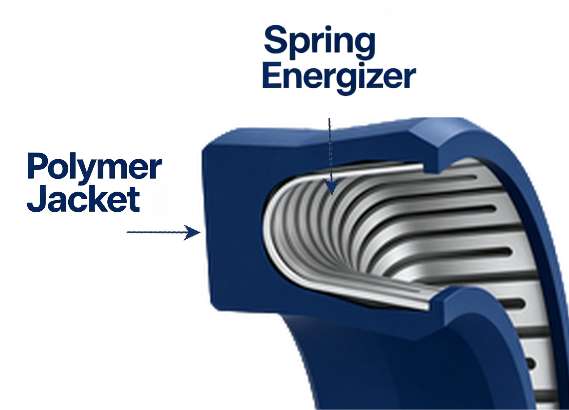
Hansealing manufactures spring energizers in-house. This allows spring geometry, alloy and load requirements to be reviewed alongside the extended heel profile and housing gland dimensions.
Hansealing manufactures the helical spring energizer in-house. Check chemical compatibility.
Gland Dimensions & Installation
The gland geometry and sealing-face condition should be selected according to the operating pressure, temperature, seal material and required leakage performance.
For custom installations, send us your housing drawing and operating conditions so our engineering team can review the sealing arrangement and dimensional requirements.
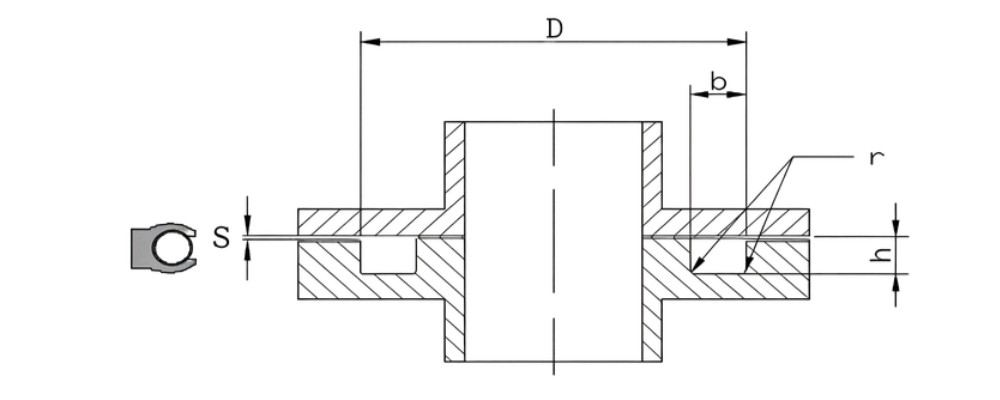
Dimensions are in millimetres, with inch equivalents in parentheses. Use the metric dimensions for machining. In formula cells, use the diameter in the units shown.
| Gland diameter D (H9) |
Groove width b (h9) |
Groove depth h |
Corner radius r |
Maximum extrusion gap Smax at differential pressure | |||
|---|---|---|---|---|---|---|---|
| 2 MPa | 10 MPa | 15 MPa | 20 MPa | ||||
| 8.0–14.9 (0.315–0.587) |
2.3 (0.091) |
1.3 (0.051) |
0.15 (0.00591) |
0.08 (0.00315) |
0.05 (0.00197) |
0.03 (0.00118) |
0.02 (0.00079) |
| 15.0–24.9 (0.591–0.980) |
2.9 (0.114) |
1.8 (0.071) |
0.2 (0.00787) |
0.08 (0.00315) |
0.05 (0.00197) |
0.03 (0.00118) |
0.02 (0.00079) |
| 25.0–34.9 (0.984–1.374) |
3.3 (0.130) |
2.3 (0.091) |
0.25 (0.00984) |
0.10 (0.00394) |
0.07 (0.00276) |
0.05 (0.00197) |
0.03 (0.00118) |
| 35.0–44.9 (1.378–1.768) |
4.1 (0.161) |
2.8 (0.110) |
0.3 (0.01181) |
0.10 (0.00394) |
0.07 (0.00276) |
0.05 (0.00197) |
0.03 (0.00118) |
| 45.0–54.9 (1.772–2.161) |
4.9 (0.193) |
3.3 (0.130) |
0.35 (0.01378) |
0.12 (0.00472) |
0.08 (0.00315) |
0.06 (0.00236) |
0.05 (0.00197) |
| 55.0–64.9 (2.165–2.555) |
5.7 (0.224) |
3.8 (0.150) |
0.4 (0.01575) |
0.12 (0.00472) |
0.08 (0.00315) |
0.06 (0.00236) |
0.05 (0.00197) |
| 65.0–74.9 (2.559–2.949) |
6.5 (0.256) |
4.3 (0.169) |
0.45 (0.01772) |
0.15 (0.00591) |
0.09 (0.00354) |
0.08 (0.00315) |
0.06 (0.00236) |
| 75.0–84.9 (2.953–3.343) |
7.3 (0.287) |
4.8 (0.189) |
0.5 (0.01969) |
0.15 (0.00591) |
0.09 (0.00354) |
0.08 (0.00315) |
0.06 (0.00236) |
| 85.0–94.9 (3.346–3.736) |
8.6 (0.339) |
5.3 (0.209) |
0.55 (0.02165) |
0.20 (0.00787) |
0.10 (0.00394) |
0.09 (0.00354) |
0.07 (0.00276) |
| 95.0–119.9 (3.740–4.720) |
9.1 (0.358) |
5.8 (0.228) |
0.6 (0.02362) |
0.20 (0.00787) |
0.10 (0.00394) |
0.09 (0.00354) |
0.07 (0.00276) |
| 120.0–144.9 (4.724–5.705) |
9.7 (0.382) |
6.3 (0.248) |
0.65 (0.02559) |
0.25 (0.00984) |
0.12 (0.00472) |
0.1 (0.00394) |
0.08 (0.00315) |
| 145.0–169.9 (5.709–6.689) |
10.5 (0.413) |
6.8 (0.268) |
0.7 (0.02756) |
0.25 (0.00984) |
0.12 (0.00472) |
0.1 (0.00394) |
0.08 (0.00315) |
| 170.0–194.9 (6.693–7.673) |
11.3 (0.445) |
7.3 (0.287) |
0.75 (0.02953) |
0.3 (0.01181) |
0.14 (0.00551) |
0.12 (0.00472) |
0.1 (0.00394) |
| 195.0–219.9 (7.677–8.657) |
12.1 (0.476) |
7.8 (0.307) |
0.8 (0.03150) |
0.3 (0.01181) |
0.14 (0.00551) |
0.12 (0.00472) |
0.1 (0.00394) |
| 220.0–244.9 (8.661–9.642) |
12.9 (0.508) |
8.3 (0.327) |
0.85 (0.03346) |
0.35 (0.01378) |
0.15 (0.00591) |
0.14 (0.00551) |
0.12 (0.00472) |
| 250.0–274.9 (9.843–10.823) |
13.7 (0.539) |
8.8 (0.346) |
0.9 (0.03543) |
0.35 (0.01378) |
0.15 (0.00591) |
0.14 (0.00551) |
0.12 (0.00472) |
| 275.0–299.9 (10.827–11.807) |
14.5 (0.571) |
9.3 (0.366) |
0.95 (0.03740) |
0.40 (0.01575) |
0.18 (0.00709) |
0.15 (0.00591) |
0.14 (0.00551) |
| 300.0–2200.0 (11.811–86.614) |
15.3 (0.602) |
9.8 (0.386) |
1 (0.039) |
0.40 (0.01575) |
0.18 (0.00709) |
0.15 (0.00591) |
0.14 (0.00551) |
Hardware, Finish And Hardness
Specify the finish of both stationary sealing faces. For gases and refrigerants, give the medium, temperature and allowable leakage along with the finish requirement.
Surface finish reference
| Media Sealed | Surface Finish | |
|---|---|---|
| Dynamic Surface (Ra) | Static Surface (Ra) | |
| Cryogenics, Helium gas, Hydrogen gas, Freon | 0.1 – 0.2 µm (4 – 8 µin) Ra |
0.2 µm (8 µin) Ra max |
| Air, Nitrogen gas, Argon gas, Natural gas, Fuel (aircraft, automotive) | 0.15 – 0.3 µm (6 – 12 µin) Ra |
0.4 µm (16 µin) Ra max |
| Water, Hydraulic oil, Crude oil, Sealants | 0.2 – 0.4 µm (8 – 16 µin) Ra |
0.8 µm (32 µin) Ra max |
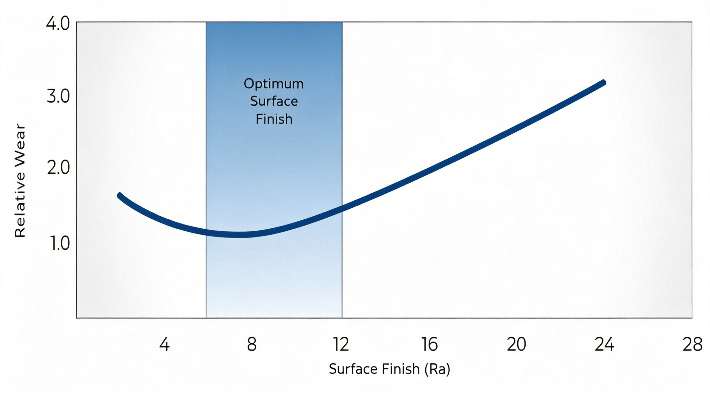
| *Important Note: Surface roughness requirements depend on sealing media, operating pressure, temperature and seal material. Excessively rough surfaces will accelerate seal wear and leakage. | ||
Seal Wear In Dynamic Surface
Need a Helical Spring Seal?
Choose the option that best describes your project.
📄
I Have a Drawing or Existing Seal
Send the existing HHS002 drawing, part number or sample dimensions with the revision and required quantity.
🔧
I Need a New Sealing Solution
Share the sealing medium, pressure, temperature, vacuum level and available installation space. Our team can help evaluate a suitable seal design and material.